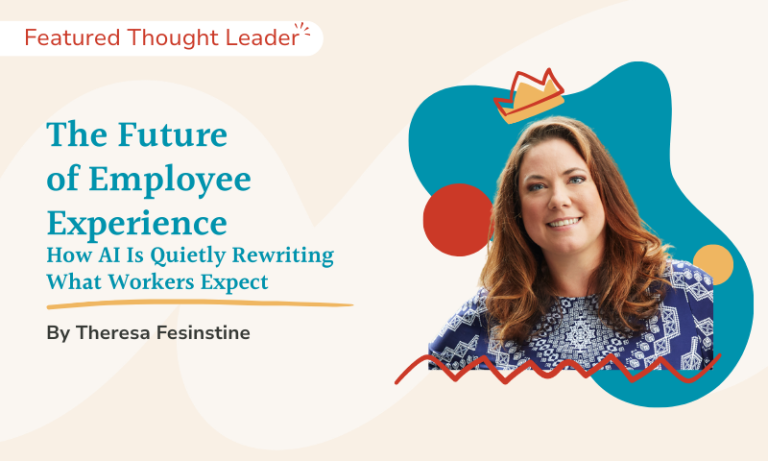

Written by Theresa Fesinstine
Theresa Fesinstine is a 25-year HR executive and founder of peoplepower.ai, a leading education platform helping HR leaders confidently adopt and apply AI at work. She is the author of People Powered by AI: A Playbook for HR Leaders Ready to Shape the Future of Work, a practical guide to integrating ethical, strategic, and human-centered AI into People and Culture teams.
She also writes People Power Pulse, a LinkedIn newsletter followed by 6,000+ HR professionals, and serves as an adjunct professor at The City College of New York, teaching AI in Business and HR Management.
Across her work as an educator, advisor, and keynote speaker, Theresa is guided by one question: how do we build a future of work that is people-first and AI-forward? She helps HR teams navigate transformation with clarity, confidence, and a commitment to culture.

Connect with Theresa on LinkedIn.
There is a shift happening in the workplace, but it is not showing up neatly in engagement scores or quarterly dashboards. It is quieter than that, more personal, and often harder to name. You can feel it in the growing gap between what people experience outside of work and what they are still expected to tolerate once they log in.
It shows up in small moments that, taken alone, might seem insignificant. A team member growing impatient with the slow cadence of internal approvals. A high performer wondering why they are still manually searching for development opportunities when consumer platforms seem to anticipate their needs without being asked. A new hire, already frustrated that getting a simple answer from HR requires navigating three tools, two time zones, and a lot of guesswork.
What sits underneath these moments is not laziness or entitlement, and it is not a lack of effort from HR teams. It is something more structural. Employee expectations are no longer shaped primarily by work itself. They are being shaped by the technologies people live with every day, and increasingly, by AI-enabled systems that quietly redefine what feels reasonable.
In my work advising HR and People teams navigating AI adoption, I see this gap emerge not from resistance, but from uncertainty about how to lead with care.
The expectation gap most organizations misread
In conversations with HR and People leaders, I often hear a familiar skepticism. It usually sounds measured and well-intentioned. “We’re not sure our people are ready for this.” Or, “We don’t want to depersonalize the employee experience.”
Those concerns make sense on the surface, but they are built on a false premise. Employees are not encountering AI for the first time at work. They are already using it daily. At home. On their phones. Increasingly, in their workflows, whether or not their organization has formally acknowledged it.
What employees are asking for is not unrestricted technology or blind adoption. They are asking for clarity and care. They want to understand how AI is being used, where it fits, and how it supports them rather than quietly evaluating them. When organizations hesitate, it is often framed as protection. But when that hesitation turns into gatekeeping, it creates a different risk. People start experimenting on their own, without shared guardrails, and the organization loses the opportunity to design trust intentionally.
The idea that AI will dehumanize HR also misses what is actually happening. AI does not remove humanity from people systems. It exposes where humanity has been stretched too thin or deprioritized. If the employee experience already feels fragmented, slow, or transactional, AI will not cause that problem; it will make it more visible. It will raise the standard for what “support” looks like, and it will surface where HR is carrying more load than it should without the infrastructure to match.
So the question is not whether AI belongs in HR and EX. The more honest question is this: How do we design empathy at scale, inside systems that were never built to deliver it?
What quiet AI adoption actually looks like inside real organizations
The most meaningful AI-enabled changes rarely look like transformation programs. They look like relief: Less manual work. Fewer dead ends. Faster access to answers. Earlier signals. Better conversations.
At peoplepower.ai, we have had the privilege of walking alongside HR and EX teams as they explore what responsible adoption can actually look like, in the messiness of real organizations.
In one midsize company, we helped reimagine their engagement analysis process using natural language processing. What once took six weeks of spreadsheet wrangling and manual theme coding now takes hours. That time was not just saved; it was redeployed into higher-value employee focused work, including listening circles, manager enablement, and deeper cultural diagnostics. The win was not efficiency. The win was capacity, and what that capacity made possible.
In another case, a global client used predictive tools to surface early burnout signals within a customer care team. The important detail is what happened next. They did not issue a blanket mandate or roll out another generic well-being campaign. They equipped managers with context, training, and language so they could respond in a way that felt human rather than performative. What followed was not just a reduction in burnout indicators. It was an increase in trust, because employees felt seen earlier and supported more consistently.
These are not flashy AI stories that depend on novelty. They are real examples of teams exploring what is possible with care, enabled by technology and expressed through humans. That is the pattern worth paying attention to.
How HR leaders can respond without losing the plot
One of the biggest risks right now is that HR gets pulled into the wrong kind of urgency. The market wants strategies, platforms, and roadmaps. Vendors want use cases. Leaders want quick wins. Meanwhile, employees want something simpler and harder at the same time. They want work to feel less frustrating. They want support to feel more accessible. They want systems to feel like they were designed for humans.
HR teams do not need another AI strategy deck. We need grounded, human-first actions that help HR teams move forward without creating fear, confusion, or unintended harm.
Here is where I recommend starting:
- Start with your values, not your tech stack.
Before you choose tools, define the principles you want to protect. What does fairness mean in your organization? What does transparency require? Where will humans always stay accountable? Values become operational when they guide which use cases you pursue, which data you use, and how you communicate decisions.
- Educate leaders on AI fluency and emotional fluency.
AI readiness is quickly becoming a leadership competency. Leaders need enough literacy to ask good questions, interpret outputs, and understand limitations. They also need emotional fluency to recognize how AI changes trust dynamics, how employees interpret “automated” decisions, and how to respond with context and care. Make this part of manager development, not a one-time lunch and learn.
- Redesign EX journeys through the lens of personalization and prediction.
Look at the moments where employees feel lost, delayed, or unsupported. Onboarding. Internal mobility. Performance cycles. Leave and benefits. Well-being. In each journey, ask what could become more responsive, more proactive, and more personalized, without crossing into surveillance. The design question is always the same. Where can we reduce friction while increasing trust?
- Build prompt literacy as a modern form of workplace fluency.
The ability to work effectively with AI is becoming as fundamental as knowing how to search, write, or present. Prompting is not a trick. It is communication and thinking. When teams learn how to ask better questions, structure requests, and evaluate outputs, they get more value with less risk.
- Educate your teams through an HR lens, not a tech hype lens.
Most people do not need to become experts in model architecture. They need practical judgment. What kinds of work are appropriate for AI support. What data should never be entered. How to select the right tool for the outcome, whether that is drafting, summarizing, analysis, or ideation. There is no single “best” GenAI tool right now, and treating tool choice as identity is a distraction. The important skill is discernment supported by expert-led skill building.
- Encourage safe experimentation. Pilot small, share often.
Choose one process with clear value and manageable risk. Make success visible and explain what is changing, why it is changing, and what guardrails exist. Trust is built through shared understanding, not quiet rollout. When employees can see how AI supports humans rather than replacing them, adoption becomes less charged and more practical.
Final thought: The future is being built in the background.
Most organizations that will lead the next decade of employee experience will not do it through big headlines or massive overhauls. They will do it in the quiet redesign of how care is delivered at work. They will notice where employees lose time. They will fix the handoffs that create frustration. They will build systems that surface answers and signals sooner. They will equip managers to respond like humans, not policy enforcers.
They will also be honest about what AI is doing, what it is not doing, and where accountability sits. Because trust does not come from pretending technology is neutral. It comes from clarity, consistency, and the willingness to center dignity as much as efficiency.
At the end of the day, AI will not define the future of employee experience. People will. The leaders who hold both the technology and humanity with intention are the ones designing workplaces worth staying for.