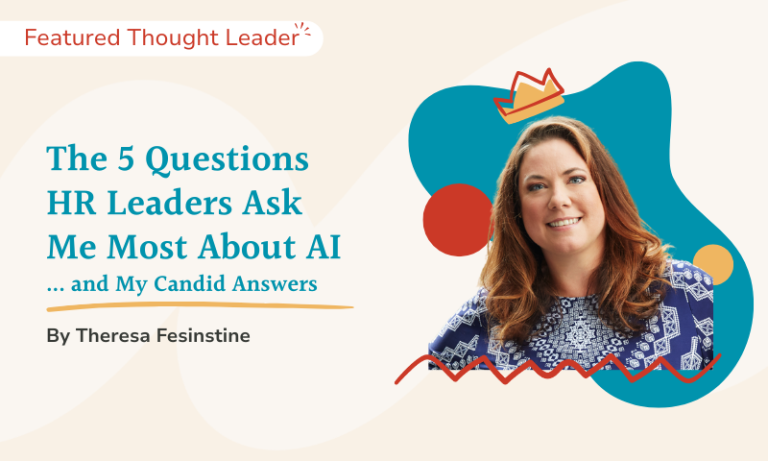

Written by Theresa Fesinstine
Theresa Fesinstine is a 25-year HR executive and founder of peoplepower.ai, a leading education platform helping HR leaders confidently adopt and apply AI at work. She is the author of People Powered by AI: A Playbook for HR Leaders Ready to Shape the Future of Work, a practical guide to integrating ethical, strategic, and human-centered AI into People and Culture teams.
She also writes People Power Pulse, a LinkedIn newsletter followed by 6,000+ HR professionals, and serves as an adjunct professor at The City College of New York, teaching AI in Business and HR Management.
Across her work as an educator, advisor, and keynote speaker, Theresa is guided by one question: how do we build a future of work that is people-first and AI-forward? She helps HR teams navigate transformation with clarity, confidence, and a commitment to culture.

Connect with Theresa on LinkedIn.
“Can I ask you something without sounding dumb?”
That’s how a lot of conversations with HR leaders start these days. I hear it during workshops, after keynotes, at my monthly AI Quick Clinics, and in DMs from people who’ve been leading culture and talent for decades.
They’re not unsure about HR. They’re unsure about AI. They don’t know how to start or what to trust, and many of them already feel behind.
What follows is a version of what I’ve shared in those off-mic, off-stage conversations. These aren’t curated answers from a product sheet or vendor deck. They come from my own work as an AI for HR Educator on a mission to help HR teams explore, adopt, and operationalize AI through a people-first, AI-forward approach.
1. “How do I start using AI if I’m not technical?”
The biggest misconception I see is the idea that there are some magical technical requirements to use AI that HR leaders don’t have. This may have been the case seven years ago when I was stuck in a General Assembly course trying to learn Tableau, but today it’s different.
Leveraging AI is a leadership skill now — not a coding one. You don’t need to become an engineer. You need to become fluent in understanding what you need and asking for AI to assist the work you already do.
The fastest way to build confidence is to use AI on tasks you already know how to do and evaluate the results. Draft a job description using your preferred structure, then ask your Generative AI (GenAI) tool of choice (e.g., ChatGPT, Gemini, Claude, Copilot, etc.) to generate a version based on it. Compare the two. Ask it to summarize a policy, prep notes for a stay interview, or analyze feedback from an exit survey. This is how you begin to understand how the tool “thinks.”
When I lead safe-to-learn sessions with HR teams, we’re not starting with tech. We’re starting with use cases. People quickly realize that AI isn’t taking their work, but it has the potential to make parts of it lighter. That’s where the confidence comes in: not from mastering the tool, but from seeing where it can make space for deeper, more meaningful work.
2. “What AI tools are actually safe, compliant, and HR-ready?”
There’s a lot of noise in the market right now, and HR leaders are understandably cautious. Every day, a new tool claims to “revolutionize HR,” but not every tool is compliant, secure, or actually built with people in mind.
Here’s the framework I offer:
- Separate experimentation from enterprise. ChatGPT might be your go-to tool for quick drafts or brainstorming, but unless you are on a team or enterprise account, it’s not built for sensitive employee data.
- When evaluating HR tech vendors, ask better questions. Don’t just ask “Do you use AI?” Ask:
- How is your AI trained and tested for bias?
- Can you explain how decisions are made (transparency)?
- What data is retained and how is it secured?
- Are you embedding AI in workflows, or layering it on top?
- How are you trained internally to leverage AI?
If they don’t have clear answers (or worse, if they can’t explain it in plain language), it’s a red flag. Stand firm that you need tools that align with your ethical standards, your regulatory responsibilities, and the trust employees place in you.
3. “How do I make sure AI doesn’t replace the human parts of HR?”
The fear isn’t just job loss. It’s culture loss. It’s the fear that, in the name of speed and efficiency, we’ll lose what makes our workplaces real: trust, conversation, relationships.
What I tell teams is this: AI doesn’t know your culture. You do.
AI can help with workflows, process optimization, summarization, and yes, even complex strategy and decision support. But it doesn’t lead with empathy. It doesn’t ask clarifying questions in a performance conversation. It doesn’t see the nuance in an employee’s shift in tone or expression. It can’t spot culture misalignment in a hiring interview. That’s your domain.
What we can do is use AI to reduce cognitive load and make more space for the emotional labor and leadership that HR excels at. For example:
- Using AI to draft the framework for onboarding communications gives HRBPs more time to meet with new hires face to face.
- Letting AI create more dynamic and exciting ways to onboard new employees creates more connected and engaged new hires.
- Leveraging secure AI tools for engagement survey insights can free up the People Analytics lead to explore root causes more deeply.
It’s not AI or People … it’s both, when you design it that way.
4. “How do I upskill my HR team so we don’t fall behind?”
There’s a quiet but persistent pressure many HR leaders are feeling: the belief that we’re supposed to already have a fully formed AI strategy, and somehow also be ready to teach it to everyone else. That kind of pressure shuts down experimentation before it even starts.
The reality is, technical certifications aren’t a realistic path forward for most HR teams. The time and the workload we all face makes the intensity of this approach daunting. The more effective — and sustainable — approach is building fluency through real-world use. Peer learning. Safe-to-try spaces. Targeted working sessions with experts. Small experiments that create forward motion without overwhelming the team.
That’s the approach I’ve built my own work around, because it mirrors how HR actually learns: by applying tools to people-centered challenges and reflecting in real time. When HR teams create conditions for learning vs. expecting immediate expertise, they not only build capability, they build confidence.
Here’s what I recommend after a foundations workshop:
- Set aside intentional time for hands-on exploration. Start with everyday use cases: prompting for a policy rewrite, role-playing a difficult conversation, or analyzing exit survey themes.
- Create internal AI learning circles. Let small teams test tools together and report back what they learned — what worked, what didn’t, what surprised them.
- Make reflection part of the process. Normalize asking questions and sharing imperfect results. You’re not trying to get it “right.” You’re building the muscle.
- Talk about how AI shows up in your workflow. Don’t treat it as a secret sidekick. Make its presence visible and discuss where it helps.
Leaders often ask, “How do I know if my team is ready?” My response usually sounds more like a challenge: What would it take to make your team feel safe enough to learn this in the open?
5. “How do we use AI ethically, without creating fear or mistrust?”
This is the question behind all the others. And it’s where HR has a uniquely important role to play.
Ethical AI starts with transparency: being clear about how you’re using AI, why, and what it means for employees. That includes training your leaders to answer questions about AI adoption with clarity and empathy.
It also means creating systems for review, escalation, and employee feedback. If you’re using AI to assist with performance reviews, you need human calibration, bias testing, and a way for employees to flag inaccuracies. If you’re using AI in recruiting, you need to audit regularly for fairness and accessibility.
The bigger point here is that AI won’t create or fix your culture. It will amplify what already exists. If your culture is built on fear and opacity, AI will extend that. If it’s built on trust, inclusion, and accountability, AI can support it.
What HR leaders can do now to prepare for 2026
2026 is going to be a turning point. GenAI will be more embedded in workplace tools, employees will be more AI-aware, and expectations will shift from “Should we use AI?” to “Are we using it responsibly?”
Here are six actions HR leaders can take now to stay ahead without rushing the process:
- Audit your current tools. Identify where AI is already present in your HR tech stack; many vendors are embedding it without fanfare. Ask the hard questions about bias, transparency, and compliance.
- Build AI literacy into onboarding and manager development. Not just for HR — across the organization. This isn’t optional knowledge anymore.
- Define your ethical AI principles. If your company values trust, inclusion, and growth, what do those values look like in an AI-powered world? Write it down. Share it. Use it.
- Start documenting wins and missteps. Keep a shared space for learnings across teams. When AI breaks down, make sure you capture it. These stories will shape your adoption roadmap.
- Design for trust, not just compliance. Focus on how AI impacts relationships, clarity, and experience. Employees can feel the difference.
Final thought
Every HR leader I’ve spoken with over the past year is navigating some version of the same challenge: how to stay human in the age of systems. I don’t believe we have to choose between people and progress. I believe we can lead both.
If you’re in the early stages of AI adoption, or still unsure where to start, know this: it’s OK to move carefully. And I’m happy to help you along your learning journey!
And take a breath. … You don’t need to have all the answers. You just need to keep asking the right questions, and bringing your team with you.