
Not all of us work in construction. (And it’s a good thing — you don’t want me to build you a house.) But all of us can relate to a simple concept: You need a sharp saw to cut down a tree. And when it comes to employees working to achieve business goals, the same principle applies. So how can you create a blueprint for talent development?
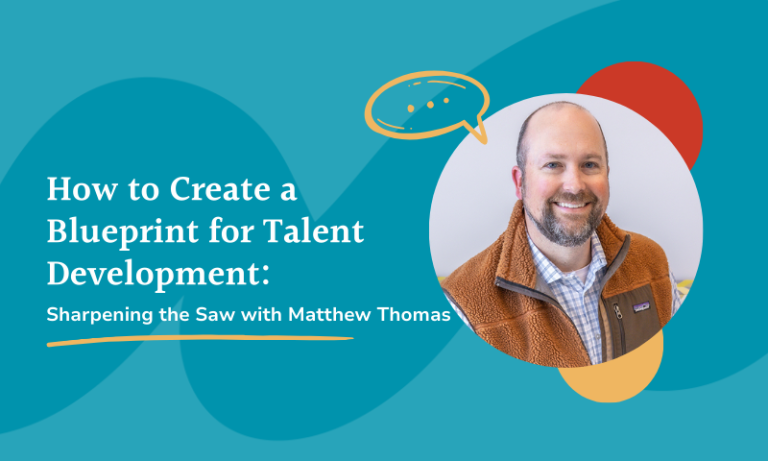
I recently had the pleasure of sitting down with Matthew Thomas, VP of People and Organizational Development at Conger Construction, for an episode of our Compt podcast ‘Getting Personal.’ Thomas shared with me about his approach to talent development and how to get organizations to make a concrete commitment to developing their people (too heavy on the construction metaphors? I’ll stop).
![Quote from Matthew Thomas: Helping people achieve their goals, putting them in a position where they can be successful [and] utilize what comes most naturally to them… if we can figure that out, I truly believe organizations will be high-performing organizations. That’s just what I’ve seen, and I love it.](https://compt.io/wp-content/uploads/2025/03/how-pd-leads-to-high-performance.png)
Here, Thomas breaks down his journey from mentee to mentor and shares the blueprint he uses to convince companies that professional development is worth it.
Getting to know people
Initially, Matthew Thomas didn’t plan to go into HR. “When I was going through college, I took like one HR class. They talked about policy and procedure. HR didn’t necessarily move me.”
But at his first full-time job, Thomas had a mentor who was strategically setting him up for success — helping develop his talent before Thomas knew what talent development even was. And slowly, Thomas began to feel out his strengths: building trust, building relationships, and partnering with organizations or departments to achieve culture change to improve employee retention.
“Our safety record wasn’t really where we wanted it to be. I didn’t know anything about safety. [My mentor] entrusted me to take over the whole safety program.”
Thomas was responsible for learning complex rules and regulations and communicating them to the 150 employees involved in the manufacturing sales and services company.
In the first year, the company improved their OSHA recordables by 66%.
“And at the end of the day,” he adds, “we went almost 1,300 days without an OSHA recordable.” All thanks to Thomas’s mentor believing in him and putting him in a position to make the change.
Along the way, Thomas learned lessons that he would take with him for the rest of his career to help him create a blueprint for talent development. One Friday afternoon, his mentor was walking around the floor of a manufacturing facility making small talk, asking about each person’s children by name. To Thomas, this was an obvious waste of time. There was work to be done!
“This was a total trap for me. I go up there, this young punk… I’m like, these people are trying to work, let them go work.”
Thomas’s mentor put his arm around him and said:
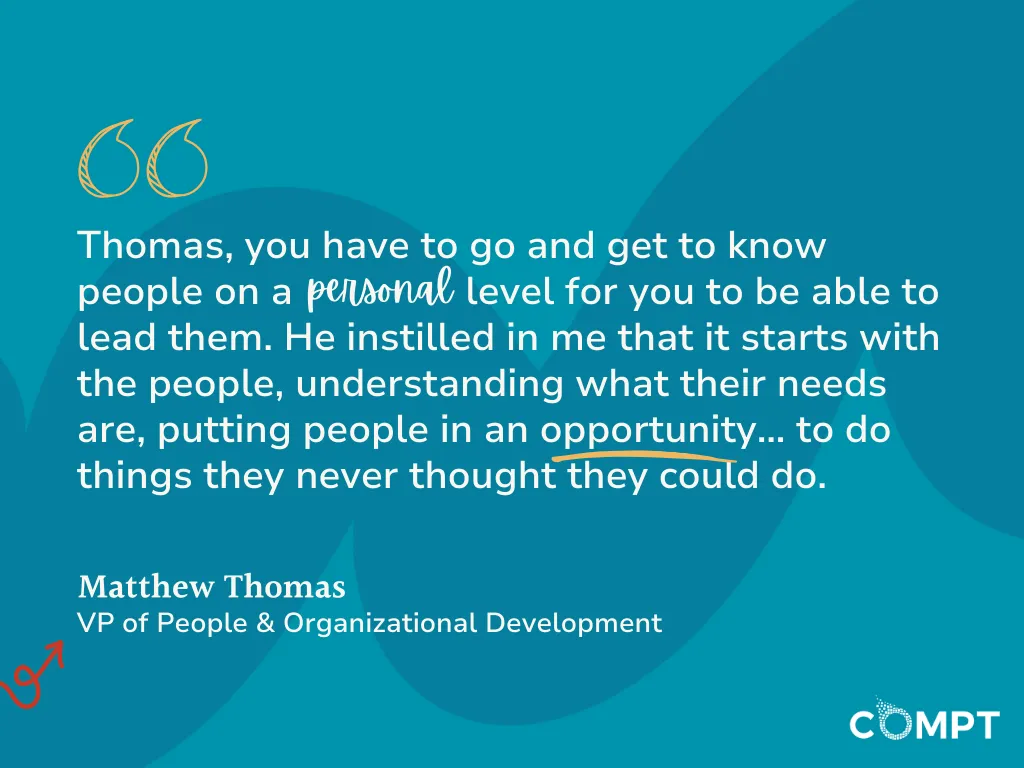
Thomas’s mentor was a high-level leader in the organization. He undoubtedly had a million things going on at any given moment. But he still took the time to invest into Thomas early in his career.
And now Thomas is investing in others as he continues his own talent development work — Friday afternoon small talk required.
(Pro tip: If you’re struggling to squeeze in professional development among your other on-the-job tasks, Compt saves you time by providing a single centralized system that automates workflows and budget tracking while giving employees self-service access.)
Building a leadership blueprint alongside a talent development framework
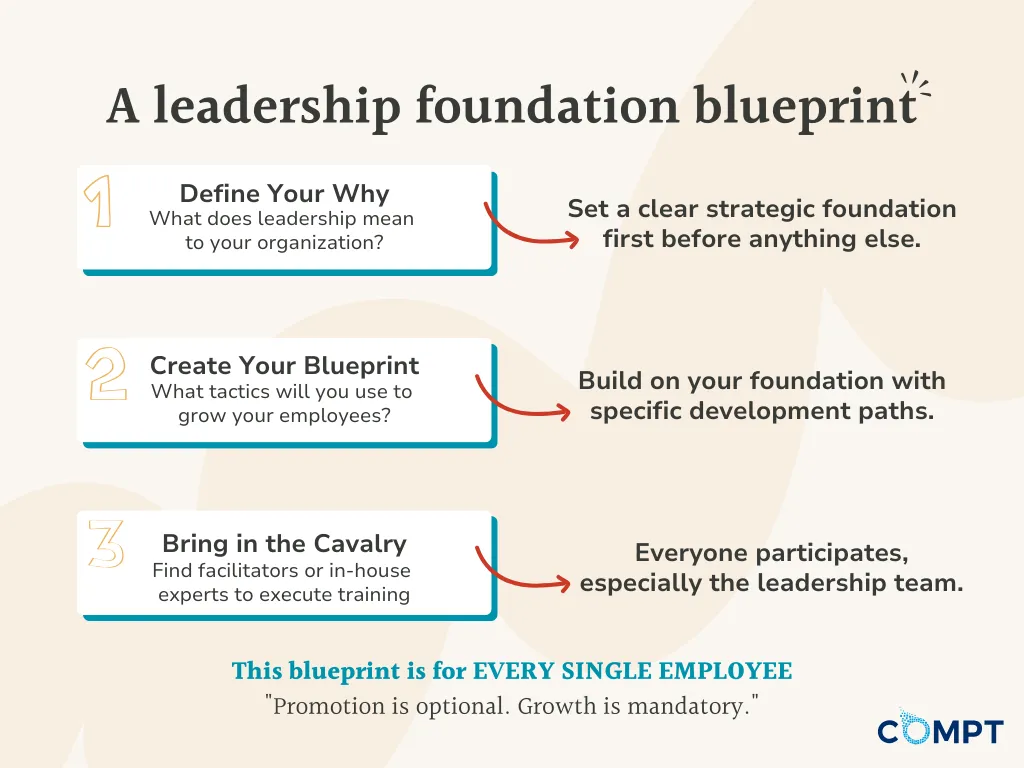
Many years down the road from that first full-time job, Thomas’s career has now spanned several industries, from manufacturing to healthcare to construction. Has his approach to professional development changed for each one, even as professional development trends shift? Essentially, no. He’s taken his lessons to heart in how to create a blueprint for talent development (and for leadership).
“You have to establish a clear strategic foundation first. That hasn’t changed. But the means and the ways of executing on your strategy have definitely changed. Online learning, automation, podcasts… all of those things are truly great and vehicles to the end goal. But the bottom line is the foundation. [It] doesn’t really change.”
Thomas puts it this way. When he walks into an organization, they first need to define their why — what leadership means to that organization. Once they figure out that foundational definition, they can build on it to create a blueprint. After everyone is on the same page, he moves forward finding facilitators or in-house experts to execute on the training.
And one other non-negotiable? Everyone needs to participate.
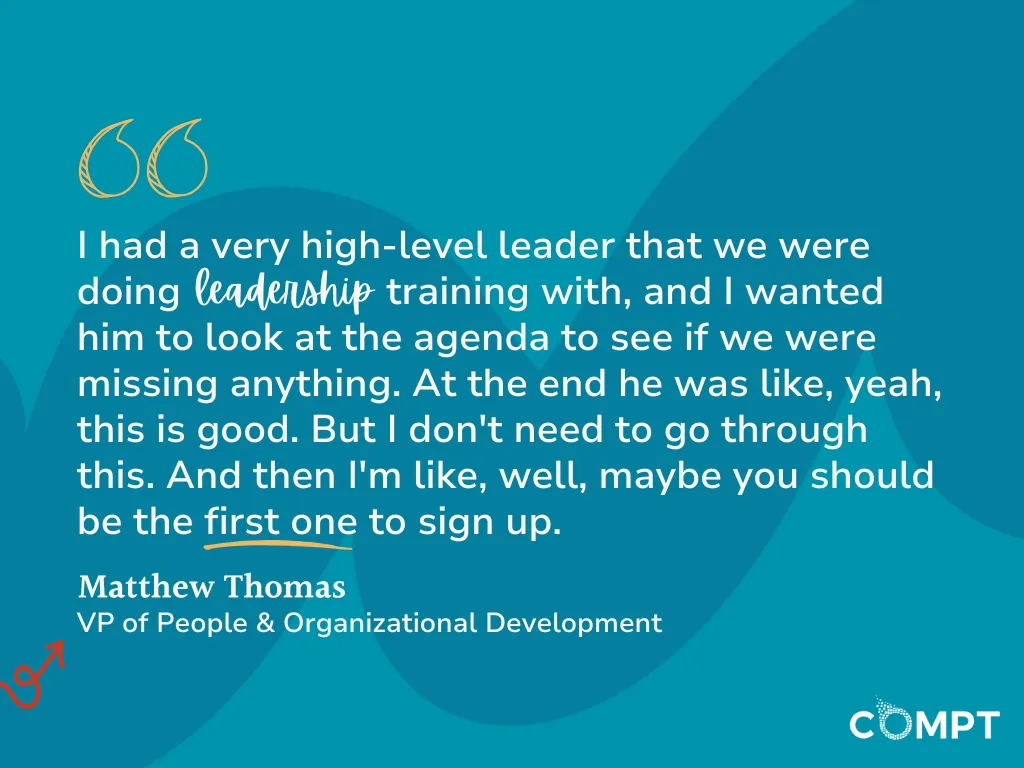
If you have high-level leaders in an organization who aren’t interested in going through something they’re sending their own employees through, that sends a clear signal about their attitude, their character, and their own leadership skills.
Personal development isn’t something you graduate from. There isn’t a point where you can sit back and relax. This is a journey that should continue throughout the rest of your career, no matter what level of your career you might reach.
Sharpening the saw (of talent development)
Whether people are trying to get out of professional development or they’re simply busy with their to-do list (raising my hand on that one), I figured Thomas might hear a common protest: “This is going to take me away from my work!”
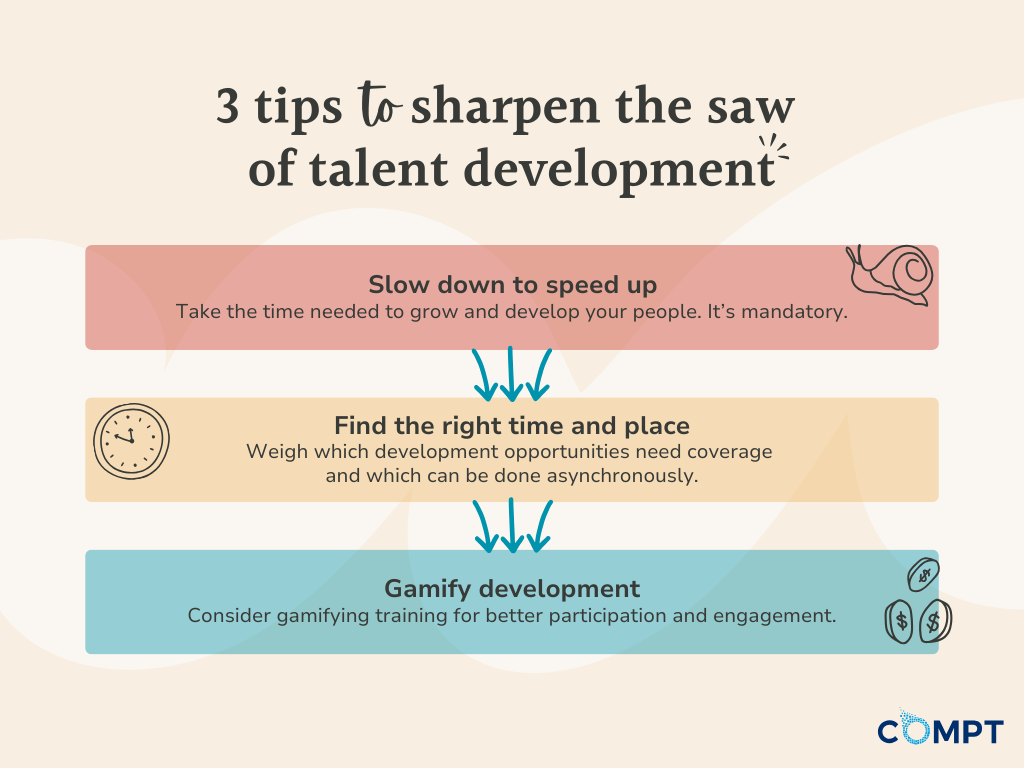
He does — and for those people, he has a response prepared. Their job is to grow and develop their full-time job. That’s part of their job. That’s part of the responsibility.
“One of the leaders of the organization I worked for once said, ‘Promotion is optional. Growth is mandatory.’ Put it on your calendar just like a meeting. There’s a saying:
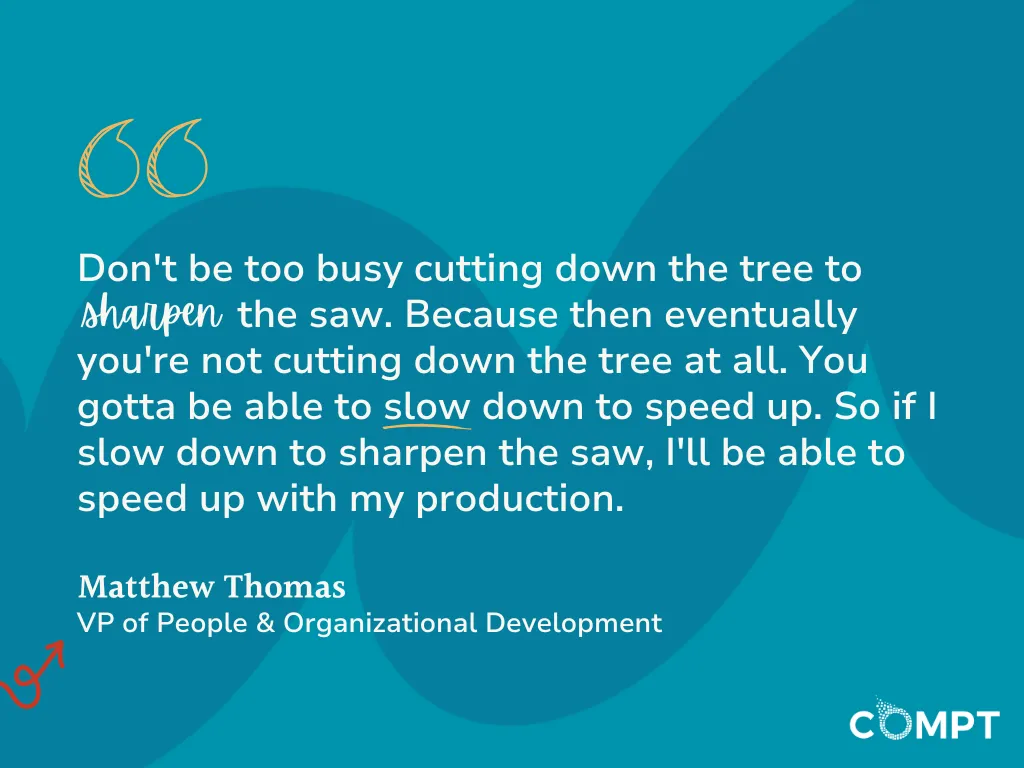
But practically, how do you deliver training when people have jobs to do? Thomas thinks this is largely situational depending on what the training is. Maybe you have a leadership training course focusing on relationship building. In that case, you may just need to plan ahead to get coverage, knowing that the value of you being off the job learning for those few days is greater than the value of you being there.
In other cases, professional development training could be done asynchronously. Thomas shares an example from a decade ago that worked well for his organization: “Depending on what the training is, sometimes you have to go to your customer. We created this gamification training program that was online where people, no matter where they were, could just log onto the computer and accomplish a challenge that was sent to them.”
By completing challenges, employees earned points that showed up on a public leaderboard. A winner was declared at the end of the 13-week challenge. (You can use Compt for a skill development program like this one.) But the important part was that Thomas helped his company achieve its goals of knowledge transfer.
“We got feedback, ‘While I was killing time with this concrete pour, I was able to jump on, do the challenges, learn what I needed to learn, and then move on to the pour.’ So it all depends on what you’re trying to accomplish and aligning the vehicle to the end goal.”

Break new ground with Compt’s professional development platform
These days, Thomas himself is working on his mental toughness, aiming to be someone who is a calm, strategic leader for others in chaotic circumstances. And for Conger Construction, he’s excited to build relationships and help people make an impact — in their community and beyond.
“And what that looks like is building a blueprint. That’s why I wake up in the morning, right? If we can put together that solid foundation for people to build their lives around, and knowing that I was part of creating that blueprint… that’s a purpose I can feel really, really good about.”
Create your own professional development blueprint with Compt. Professional Development Pro by Compt streamlines requests, approvals, and budget tracking, creating simple workflows in a single location where employees can grow and develop.
Schedule a demo to see how Compt can help you manage professional development requests.