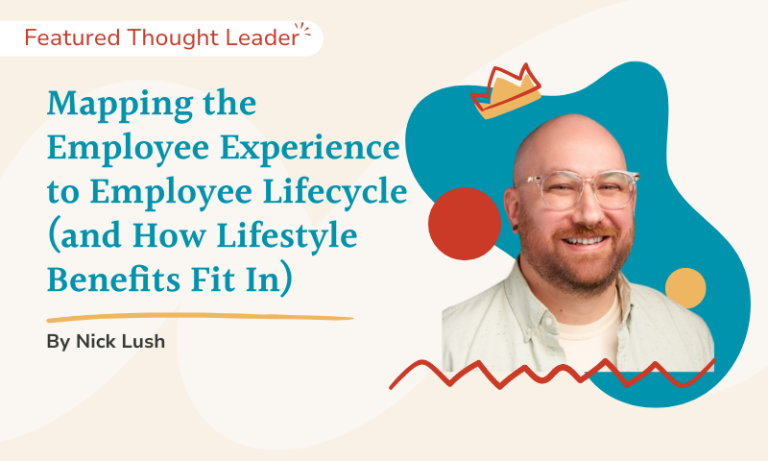

Written by Nick Lush
Nick Lush is the Director of Learning & Development at BeatBox, where they build people-first programs that scale with heart. With five years of experience in L&D and people development, Nick is known for designing impactful, human-centered learning strategies that solve for the business and employee growth at every level. They’ve worked with organizations like Tandem, Included Health, and Hunt Club, and they’re sharing insights on what it’s been like to build resilient, empowered, and engaged teams.
Connect with Nick on LinkedIn.

It’s our remit as Human Resources professionals to try to balance providing the best possible employee experience that we can with strategic goals and limitation of liability. It’s a never-ending juggling act, and it’s also one that tends to miss the forest for the trees.
There are reasons for this; obviously, many HR departments are scrambling to get by with too few personnel, too few resources, or a combination thereof. However, many departments are making things more difficult than they need to be by reacting to situations as they arise or responding to directives from above without considering the wider implications for continuity of experience. To be fair, this sort of stuff isn’t really taught in HR school. Trust me, I know.
As I’ve gotten started in HR, transitioning into Learning & Development in 2020 after a long career in marketing, I’ve found that there are three core marketing concepts that are incredibly useful in both building and disseminating HR programs.
Concept #1: You’ve said it once, but you really have to say it 1,000 times.
One mistake I often see HR professionals make (and I’m guilty of it, too!) is giving up on messaging or a program too quickly because it didn’t sink in right away. We forget just how busy our peers are or we overestimate how clearly we communicated something and, because it doesn’t see immediate results, we move on to the next thing on our urgent to-do list.
One of the biggest things that HR teams can implement to make programs like employee stipends, learning initiatives, or wellness programs more effective is taking the time to map out a thorough, targeted, and “omnichannel” messaging strategy. As you might guess from the word itself, “omnichannel” is a concept marketers use to describe a campaign that reaches consumers in multiple locations: often a blend of social platforms, email, digital ads, blog posts and press releases, experiential, and even telemarketing or mailings.
The same thing can be useful for HR personnel. What channels do you have access to? Are you a Slack organization or a Teams organization or something else? Email is a given. Do you have an intranet? If so, does someone on your team have admin access or editing privileges? Do you do engagement surveys? What about pulse surveys? All these are “channels” available to the HR team to get the message across. Studies show that internal audiences need to hear things as much as five times for it to stick and, in marketing, generally at least seven times for it to land!
For example, at the beginning of this year, we transitioned both our learning management system (LMS) and HR information system (HRIS). We knew these would be substantial changes to our team, and the integrations were being led by two different people (myself for the LMS and my colleague for the HRIS). Initially, we talked about how to make the transition as smooth as possible for our staff and how we could line up timing to make it easy to digest. After a few rounds of discussion, we finally came to a game-changing decision: What if we treated this not as two separate system transitions, but rather as a “refresh” of our employee tech?
From there, every decision got simpler: transitioning both systems simultaneously made more sense. Staff had an obvious and clear benefit of moving to easier, more modern systems. Timing got simpler; we no longer had to worry about launches “clashing” with each other, we just needed to figure out when they would happen so we could set clear expectations. And finally, we were able to simplify what was quickly becoming an overwhelming list of messaging points down to a simple set of concise talking points built around making the employee experience simpler and more empowering from a technical perspective.
From there, we set about building a robust campaign of marketing materials, with longer, more fully detailed explanations for email and shorter, to-the-point updates for Slack. We made memes to accompany the messaging. We wrote copy that piggybacked on current events: We sent an email the week of the new “Love Island” season premiere that positioned the transition as a break up and recoupling. We sent messaging regularly, at set intervals, with varying levels of detail. We had scripts ready for employee all-hands meetings on the run up to and after launch.

The best part? Our employees met our energy: they shared things they were able to find more easily now. They encouraged colleagues to adopt the new systems, helped each other navigate, and shared trainings. My personal favorite? I got an email from our internal copywriter telling us that he “loved” getting our emails, that our copy “slapped,” and that it meant a lot to him to see HR caring about getting the messaging right.
When’s the last time you got a response to an email from a member of staff just to tell you they enjoyed reading it? By putting the employee experience first in our rollout plan, we took an initiative that could have caused frustrations and stress and instead turned it into a chance to build engagement and heighten the perception of HR as a function.
Concept #2: Your communications should be customized to the “personas” of your personnel.
From there, you’ll want to determine how many employee “personas” you have. In marketing, personas are used to determine broad sketches of the members of a campaign’s audience who have different motivations or means of being reached. Teams use this information to build campaign assets and decide how to distribute them.
The same practice is useful in HR: communications should probably be altered to target leaders vs. managers vs. longtime professionals vs. entry-level staff. They each have different needs in terms of informational complexity as well as various responsibilities for amplifying that message across the organization. You’re likely better off providing leaders and managers with checklists and talking points to reinforce your programs, while lower-level or individual contributor staff members likely just need to know which changes impact them and how. In all cases, it’s always useful to include a “why” that can help frame future feedback and provide some grounding for why the change is happening now.
Finally, you need to make sure the communication plan is thorough. By this, I mean that it can’t just be an announcement at one meeting and then an email. Some of my colleagues are getting hundreds of work emails every day. There’s pretty good odds that one message might slip through the cracks and they’ve missed it. Here’s how I like to approach it:
- Structure your “campaign” with an informational bell curve around the launch date of the change to build buy-in and secure adoption afterward. By starting broad and focusing on benefits, you build excitement.
- As you get closer to launch, get more detailed with steps the user needs to take and screenshots or recordings to help them navigate. Distribute any training materials that are needed to coincide with launch.
- Finally, launch messaging that follows up post-launch to reinforce the change and highlight early results or user wins that underline the change’s value.
By having a robust marketing strategy for your initiatives, you present a more forward-leaning image of HR to the team, cut down on repetitive questions, and make more time for hearing and adapting to feedback or working through the next issue.
All of this is great, but there’s another lesson from the marketing world that makes all of this even more effective, and that’s taking the time to map the lifecycle of your employees.
Concept #3: From the first day to the final two weeks, consider what working for your business feels like.
On the People & Culture team at BeatBox, we talk a lot about wanting to create a culture that people are “alumni” of, rather than a business people used to be a part of. What does that mean? Ask any recruiter you know; they no doubt have seen a ton of LinkedIn profiles on which people tout the names of companies they used to work for. Sometimes, that’s just because it’s a hot brand they know recruiters like to search for, but often it communicates something about their experience there and what they think it says about them.
So, how do you build that? Well, just like with IKEA furniture, it starts with having a sketch of what it is that you’re trying to build, the parts you have available to do it, and what each step should look like along the way.
We all likely have a sense of what we hope employees think and feel about working for our business. Most organizations have taken the time to develop a mission statement and some values to go with it. We spend time trying to build and maintain a definable “culture.” But what we often miss is what culture is made of: in a business or a society, culture is based on shared experiences, shared values, shared references, and shared beliefs.
If we want to build a healthy and scalable culture, we have to start with not just thinking about the employee experience at our business, but what the lifecycle of working for us looks like. What is the first day like? The first week? What’s the day to day like? What recognition is there for anniversaries and big wins? How are failures handled? How do exit interviews feel? These are all crucial elements to building and maintaining culture that are always better when they feel consistent from start to finish.
I encourage every HR team to spend time at your next team summit or in an upcoming team call to start to think about the phases of the employee lifecycle. Some basic buildings blocks include:
- Recruitment
- Onboarding
- First 90 days
- Advancement
- Anniversaries
- Offboarding
In the middle, you can start to get more detailed about major life events. Are you proud of your parental leave policy? Does your company offer generous bereavement leave? Are people satisfied with their lifestyle benefits? Does the usage of your lifestyle benefits indicate that they are a good match for the actual, current lifestyles of your staff? Take the time to map out what the experience of engaging those resources should look like. Document it so that everyone on the team has a playbook to work from.
While this might start off feeling like a lot of hypothetical work and like you’re painting an overly broad picture of what employees will experience, what you’ll find as you start to really hone in on a specific version of events is that what you’re really building is your vision of the employee experience and, importantly, concrete steps to achieve it. As an added bonus, you’ll also have an easier time facilitating things like PTO or unexpected leaves within your own team, because the process for handling different potential issues is already clearly documented.
This might all feel like a lot to take on given your team’s current workload and resources. I hear you. The list of things for HR to tend to is long and arduous. Once you get into a cycle of reacting to issues as they arrive, it’s tough to break out. But this is a situation where I would argue the old adage that “an ounce of prevention is worth a pound of cure.”
By briefly hitting “pause” and taking time — first as a team, and later with leadership — to map out your desired employee lifecycle, I think you’ll find it makes work easier to prioritize, issues easier to settle, and presents your team with opportunities to add proactive value to your organization.