

A common question every HR leader hears when launching a stipend program is: “Do we really need a vendor for stipends? Let’s just manage it ourselves.”
On the surface, it makes sense. You already have:
- Payroll
- An expense-management tool
- A helpful HR team ready to jump in and manage it
So why not repurpose what already exists?
Because what seems like a quick, cost-saving shortcut almost always becomes a slow leak of cross-departmental time, data accuracy, and employee trust.
Below, we’ll walk through the three most common “keep it in-house” paths we’ve seen, the hidden costs they create, and the ripple effects they cause over time.
What LSA providers actually do
Before we get into the hidden costs of managing stipends in-house, let’s define what Lifestyle Spending Account (LSA) providers actually are — and why they exist.
What is an LSA provider?
An LSA provider is a benefits platform that helps you design, fund, and manage a Lifestyle Spending Account program.
LSAs are employer-funded, post-tax accounts that employees can use for things like wellness, family support, remote work, commuting, and professional development — within the guardrails you define.
Instead of locking employees into a single gym membership or a rigid perks marketplace, LSAs give them a flexible stipend budget and a menu of eligible categories to choose from.
Common examples include:
- Health and wellness: gyms, fitness apps, nutrition support, wearables, equipment
- Family and caregiving: childcare, elder care, fertility support, pet care
- Remote work: office furniture, tech, internet
- Professional development: courses, conferences, certifications, AI subscriptions
- Lifestyle and well-being: hobbies, travel, mental health apps, or financial wellness tools
What LSA providers handle
An LSA provider takes care of the messy middle — everything that’s complex or risky to manage manually:
- Building the categories and eligibility rules
- Powering reimbursements or card-based spending
- Handling taxability logic and payroll/finance exports
- Providing reporting for HR and Finance to track usage and ROI
- Supporting employees when they have questions about what qualifies
DIY vs. using an LSA provider
You can absolutely try to DIY an LSA. Many companies start with:
- A Google Sheet, Excel doc, or HRIS note to track each employee’s balance
- Expense reports or inboxes full of questions and receipts
- Manual tax coding for every individual reimbursement
That works — for a minute. Then:
- Admin time expands as participation goes up.
- Inconsistent decisions make equity and compliance tricky.
- Finance loses clean visibility into spend, liability, and taxes.
LSA providers exist to centralize and automate those workflows so your team doesn’t have to.
They bring together:
- Design: categories, eligibility, and budgets
- Execution: how employees spend and submit
- Compliance: tax logic aligned to IRS rules where applicable
- Insights: adoption, category usage, and team spend over time
In other words, the right LSA partner lets you offer modern, personalized benefits without turning your HR and Finance teams into full-time stipend accountants.
“We cut our benefits processing time from weeks to just 90 minutes.”
“I spend about five minutes a week in Compt — just running reports and preparing payroll. When I need to do something, I go in, do it, and get out.”
Three options for “keeping it in-house”
Now that we’ve covered what an LSA provider actually does, let’s look at what happens when companies try to manage stipends internally.
In nearly every organization, this takes one of three forms:
- Tracking everything manually in spreadsheets.
- Using an existing expense-management tool to handle reimbursements.
- Adding the stipend directly to paychecks.
These options seem reasonable at first glance — but each one hides real costs, risks, and ripple effects that compound over time.
Option 1: Tracking stipends manually (spreadsheets, email, Slack)
At first, spreadsheets seem simple. One column for employee names. One for stipend amounts. One for reimbursements. And another for remaining balances.
However, over time, they become an operational burden on HR and Finance and a second job for whoever is “owning” the program.
“We had a wellness program that we were in the process of sunsetting just because of the administrative hurdle of making sure it was tax compliant. We have a small finance and HR team to handle that.”
The 5 hidden costs of manual tracking
Hidden cost 1: Admin hours increase (and rarely decrease).
The amount of time it takes to manage a program manually at launch is often the least amount of time a person will ever spend managing a program.
That said, it’s because the program is new and unused, and every data column works (or should work) perfectly.
But the reality is that as more people use your program, it begins to increase in complexity, and thus effort.
Let’s look at an example. For a 250-person company offering a $500 annual wellness stipend:
- 250 employees × 12 submissions/year × 10 minutes to review and log each = 500 admin hours per year
At a conservative $40/hour blended HR/Finance rate, that’s $20,000 per year spent on required actions like:
- Reviewing receipts for accuracy
- Checking eligibility
- Adding reimbursements through payroll
- Updating spreadsheet balances
- Emailing Finance and employees
That’s the equivalent of more than three full work months of effort — just to process a stipend program manually.
It doesn’t include the time employees spend chasing approvals or asking, “Did my reimbursement go through?”
And it also doesn’t include the time it takes to ensure that every bit of dollar and cents is accurately added, communicated, and reimbursed in a timely manner.
Some questions for you to consider with this path would be:
- Are you planning to reimburse people immediately, or on a specific pay cycle?
- How will you handle the program if the person managing it is OOO for vacation or an emergency?
- Will you rerun payroll for late submissions or hold them for the next cycle?
- What will you do if any numbers are transposed inaccurately? Will you adjust their balance? If they were overpaid, will you request the funds back? And what will this do to the program and HR’s credibility?
Ripple effect:
- Immediately: HR and Finance lose multiple hours each week to low-value admin work.
- After one year: That “just a few hours a week” turns into dozens of lost strategy days. Projects that help retention, recruiting, employer brand, or culture get delayed because stipends need reconciling.
- After a few years: The program is either abandoned (“too much work”) or continues along in a half-broken state that nobody wants to manage.
“Before Compt, every reimbursement felt like detective work. It was on us to figure out what people were eligible for, not the system.”
Hidden cost 2: Compliance becomes a continual guessing game.
Without automation, someone has to decide line by line:
- What is taxable vs. nontaxable
- Which IRS rules apply (e.g., certain education or remote-work expenses)
- What needs to be reported through payroll
- Where to put receipts (in the event of an audit)
Every row in the spreadsheet becomes a mini tax decision.
Here’s a thought exercise:
Imagine 250 employees submit four stipend expenses each per year = 1,000 transactions. If even 5% of those need special handling, that’s 50 cases in which HR or Finance must stop, research, and decide how to treat the expense.
Each of those 50 decisions has to be documented, explained, and retrievable, ideally with receipts and policy context attached, to satisfy IRS accountable-plan requirements.
Ripple effect:
- Immediately: HR/Finance feel a low-level anxiety: “Are we sure we did this right?”
- After one year: You’re carrying unresolved risk, and small errors in coding add up to under- or over-withholding that surfaces at year-end.
- After a few years: If you’re audited or need to restate something, it’s challenging to defend every line item from a patchwork of old spreadsheets, emails, and Slack messages.
Hidden cost 3: Errors compound quickly.
Spreadsheets are fragile, and it’s too easy for one small mistake to create a breakdown in the data:
- Someone drags a formula down incorrectly.
- A row gets overwritten.
- A column is sorted without including all data.
Prior to joining Compt, one customer told us that a single typo doubled an employee’s reimbursement amount — unnoticed until payroll reconciliation. Fixing it meant:
- Reversing the overpayment
- Rerunning payroll
- Communicating the mistake to the employee
- Updating multiple internal records
Now extend that to hundreds of entries across multiple programs.
Ripple effect:
- Immediately: You spend time firefighting individual issues (e.g., fixing balances, communicating with confused or upset employees).
- After one year: Employees start to assume the process is unreliable (“My coworker got paid, I didn’t” or “I was under-reimbursed”), and HR is perceived as disorganized.
- After a few years: Leadership starts to question whether stipends are “worth the hassle,” and the benefit is either cut or drastically scaled back — not because it was a bad idea, but because it was managed in a fragile way.
Hidden cost 4: Employees don’t have visibility, so they ask HR.
When stipends are tracked manually, employees usually can’t see important details of their lifestyle benefits program:
- Their current balance
- How much they’ve used
- Which purchases are eligible
- What’s been reimbursed (and what hasn’t)
So they ask HR. Frequently.
Every cycle brings a new round of messages:
- “How much do I have left?”
- “Is this item eligible?”
- “Can you resend the policy?”
- “When will I get reimbursed?”
- “How do I know if I’ve been reimbursed?”
Each question might take two minutes to answer. But with even 100 employees, that’s hours of time answering questions every month.
Ripple effect:
- Immediately: HR becomes the “human interface” for the stipend program.
- After one year: Your team spends meaningful time answering repeat questions instead of improving benefits, culture, or processes.
- After a few years: The stipend program has a reputation internally as “confusing” or “hard to use,” even if the budget is generous.
Hidden cost 5: Changes are challenging to make.
When you manage stipends manually, even small program changes create outsized administrative headaches.
Most HR teams launch a stipend program with the best intentions: a simple stipend, a set budget, and a clean spreadsheet.
But stipends are living benefits. Over time, leadership will want to adjust amounts, add categories, include global teams, or shift cadence from annual to quarterly to make the benefit more visible and meaningful.
That’s where manual programs begin to break, because every “small” tweak or program change creates a new layer of complexity that needs to be accounted for.
If you want to decrease a stipend during the year, many questions with complicated strategies arise, like:
- What do you do with employees who were already reimbursed for more than the new limit?
- Do you claw back funds or eat the overage?
- How do you ensure fairness across departments or regions?
Beyond that, adding new hires creates new math. Do you give them the full annual amount if they join in October? Or do you prorate based on start date, and if so, who’s manually tracking that and communicating it?
If you operate globally, the complexity multiplies. You now have to decide:
- Do all employees receive the same amount, or do you localize by cost of living or exchange rate?
- How will you track and convert reimbursements in multiple currencies?
- How do you ensure the tax treatment is correct in every country?
What looks like one line of policy text — “$500-per-year wellness stipend” — becomes a cacophony of exceptions, calculations, and decisions for every geography, hire date, and policy change.
And it becomes more challenging to adjust your program based on industry best practices. For example, Compt’s Annual Lifestyle Benefits Benchmark data shows that quarterly stipends are the most common funding cadence, likely because they drive the highest participation. It makes sense; they’re more memorable, create anticipation, and keep your company top of mind as a generous and supportive employer.
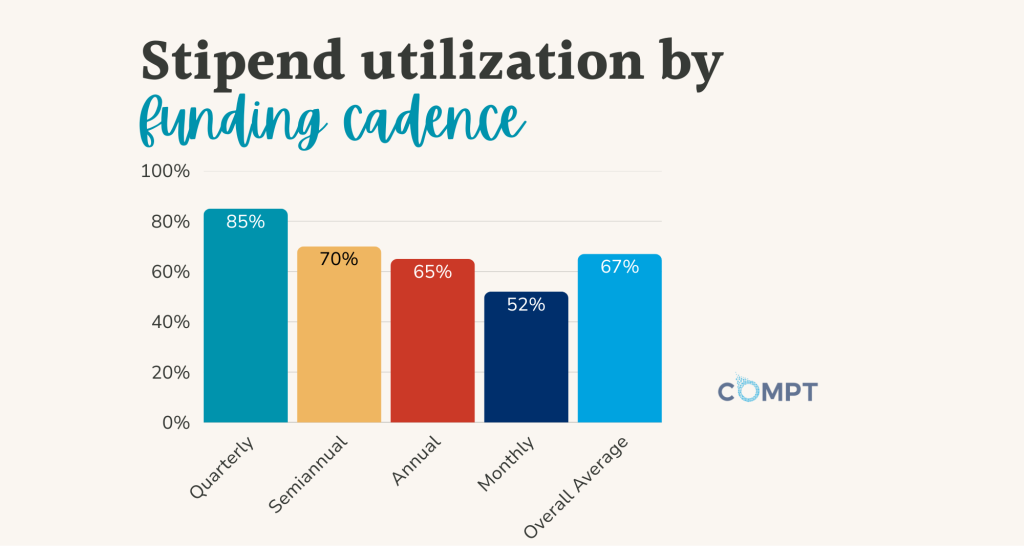
But when you’re managing manually, quarterly or monthly stipends are almost impossible to maintain. Each new period means resetting balances, reuploading data, and verifying who’s eligible again. As a result, most manual programs default to annual stipends, which sound easier but feel distant and forgettable to employees.
“We realized that when we did an annual wellness stipend, hardly anyone used it. By the time people remembered, it had expired.”
Ripple effect:
- Immediately: Program changes that should take minutes become multistep spreadsheet projects involving HR, Finance, and Payroll.
- After one year: Policy changes slow down or get delayed entirely because they feel too disruptive to manage. Employees miss out on evolving benefits that could have positive effects on their productivity, engagement, and happiness.
- After a few years: The program stagnates. What started as a flexible benefit becomes rigid and outdated, while other companies modernize and localize their offerings with ease.
Manual-tracking approach summary: what really happens over time
| Impact Area | Short-term (Reality) | 1-Year (Ripple Effect) | 3-Year (The Debt) |
|---|---|---|---|
| Admin Time | A few hours/week of “extra work” that feels manageable. | 500+ hours/year of admin time lost to tracking and syncs. | Strategic work delayed; a program nobody wants to manage. |
| Compliance | Ad-hoc tax calls made line-by-line in spreadsheets. | Mounting uncertainty about taxable vs. nontaxable rules. | Audit exposure and costly restatements during review. |
| Accuracy | Small typos quietly create payment mistakes. | Reversals and overpayments hit HR credibility. | Leadership loses trust in HR data; programs get cut. |
| Experience | Confusion about balances, eligibility, and timing. | Low and uneven engagement across teams. | Stipends viewed as unfair; participation plummets. |
| Flexibility | Policy tweaks feel simple at first. | Midyear changes require manual recalculations. | Program stagnates; annual cadence becomes rigid. |
Option 2: Using expense-management software
If you already reimburse travel or office expenses, using that platform for stipends can sound efficient.
But the problem is that expense software is built for accounting controls, not benefit programs.
It would be like asking your CFO to DJ the company party. They could technically manage the playlist, but that’s not their expertise, and no one’s dancing.
Expense tools are built for Finance to account for spend. Stipend tools are built for HR to create meaning with spend. Expense tools were made to enforce company spend policies, not create moments employees love.
The 5 hidden costs of using expense tools for stipends
Hidden cost 1: The tool is misaligned with the job.
Expense tools view purchases as liabilities: “You spent this on work, so we owe you money.”
Whereas, benefits need to feel like investments: “We care about you, and we’re funding your wellness / learning / family support.”
That difference matters in how employees behave.
- In an expense tool, stipends feel like work bureaucracy: forms, codes, approvals.
- As a benefit in a dedicated platform, stipends feel like support: clear categories, visible balances, simple submissions.
“Our people treated it like another expense report. The emotional impact was gone.”
Ripple effect:
- Immediately: Employees treat stipends like any other expense report — and money that quickly becomes owed to them.
- After one year: Engagement is mediocre. Many people don’t bother, especially if they associate the tool with tedious work tasks.
- After a few years: Leadership may conclude “stipends don’t really move the needle,” when in reality the experience was wrong, not the concept.
Hidden cost 2: The tax trap for Finance
Expense-management tools generally assume that most reimbursements are nontaxable business expenses.
They’re designed to track employees’ business travel, software costs, office supplies, and other company-related purchases.
Stipends are different:
- Many categories (e.g., wellness, family, general lifestyle) are taxable benefits that must be run through payroll.
- Some (like certain education or remote-work expenses) may fall under specific IRS sections.
Expense tools don’t usually handle those distinctions automatically, so Finance has to:
- Export stipend expenses from the tool.
- Determine which ones are taxable.
- Manually feed them into payroll or adjust general ledger (GL) entries.
A single missed taxable classification can snowball into hundreds of dollars in under-withholding per employee.
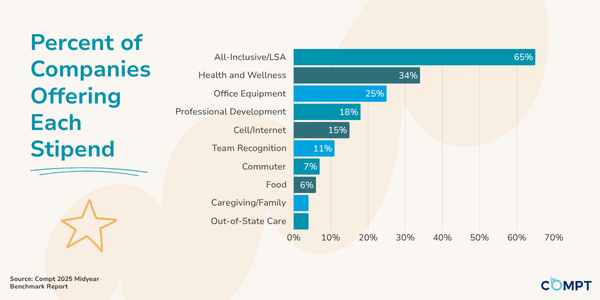
You can avoid this altogether by tightening the parameters of your program and only offering workstyle benefits like reimbursements for professional development, commuter expenses, or remote-work equipment, but then you’d miss out on creating a truly supportive program that makes your company a great place to work.
Ripple effect:
- Immediately: Finance spends extra time manually reviewing and classifying stipend expenses.
- After one year: You have a messy mix of records across your expense tool, payroll, and GL, none of which fully agree.
- After a few years: If there’s an audit or leadership wants a clear view of benefit spend and tax treatment, Finance has to reconstruct history from multiple systems.
Hidden cost 3: Expense management software costs add up.
Most expense tools charge per active user, often in the range of $9-$25 per employee per month.
At 500 employees, that’s: $54,000-$150,000 per year in software licensing alone.
Before you even reimburse a single stipend dollar.
Then add:
- HR time configuring new categories
- Finance time reconciling reimbursements
- IT time managing permissions and integrations
What feels like “free” because you already have the tool quickly becomes more expensive than an LSA solution.
Ripple effect:
- Immediately: It seems like a smart way to avoid adding another vendor.
- After one year: You realize you’ve spent tens of thousands in licensing and internal time for something that still doesn’t quite fit.
- After a few years: You’re locked into a system that no one loves, and have fostered a belief that these benefits are owed to employees — making it harder to change.
Hidden cost 4: Reporting gaps decrease program visibility and impact.
Expense tools are great at telling you details like, “We spent $X this year on travel” or “We spent $Y on software.”
However, they’re not great at telling you:
- Which employees used their stipends (participation rates).
- What percentage of funds allocated are spent (utilization rates).
- Which categories are resonating (e.g., health vs. family vs. home office).
- Whether usage is equitable across locations, levels, and teams.
Without this visibility:
- HR and leadership can’t tell if the program is working.
- Finance can’t forecast accurately.
- Leadership can’t see clear ROI.
Ripple effect:
- Immediately: You get some high-level spend numbers, but not much insight.
After one year: When someone asks about the impact of stipends, there’s no real story to tell. - After a few years: Budget conversations become difficult. It’s easy for stipends to be cut when no one can clearly articulate their value. And again, it was the experience that was wrong, not the concept.
“Compt’s reporting is incredibly helpful for reconciliation and tracking. It saves me so much time — just a few quick clicks, and I get everything I need.”
Hidden cost 5: Rigidity makes every change harder than it should be.
Expense systems are not designed for flexible, human-centric benefits. So changes like:
- Adding a new stipend category midyear
- Adjusting budgets by team or country
- Experimenting with a new benefit (e.g., AI tools, caregiving support)
… often require:
- New approval rules
- New coding requirements
- Help from the Finance team
In an LSA or stipend platform like Compt, HR can often make those changes in minutes.
Ripple effect:
- Immediately: You can technically “get something live” with your existing system.
- After one year: Your program is frozen in place because every small change is painful to implement.
- After a few years: Your benefits feel outdated compared to what other companies offer because your tools won’t support your new ideas or needs.
Expense-tool approach summary: what really happens over time
| IMPACT AREA | SHORT-TERM (The Status Quo) | 1-YEAR (The Shift) | 3-YEAR (The Debt) |
|---|---|---|---|
| Employee Experience | Stipends feel like more expense reports for the team. | Moderate engagement paired with growing friction. | Perk feels bureaucratic and cold, not supportive. |
| Tax and Compliance | Manual classification sits heavy on Finance’s plate. | Growing risk and backlog of misclassified benefits. | Complex history across tools; high audit risk exposure. |
| Cost Efficiency | Internal sentiment of “We already pay for this tool.” | Licensing plus internal labor costs exceed expectations. | Higher total cost of ownership than a dedicated platform. |
| Reporting and ROI | Basic spend tracking with no deeper insight. | No clear story to tell on cultural impact or equity. | Budgets are impossible to defend or optimize to leadership. |
| Flexibility | Basic setup works for simple, static use cases. | Any policy change requires massive cross-team effort. | Strategy is permanently constrained by tool limitations. |
Option 3: Adding money to payroll
“We’re just going to add it to their paycheck,” is something we have heard many times before at Compt. Heck, some of the largest and most well-funded companies do it, so if it works for them — why wouldn’t it work for you?
And we get it. Of all the DIY methods, this one looks the easiest:
- Add $X to everyone’s paycheck.
- Call it a “wellness” or “learning” stipend.
- Move on.
No receipts. No extra software. No approvals. Hooray!
Unfortunately, this “simple” shortcut quietly breaks the purpose, compliance, and clarity of the program.
The 6 hidden costs of stipends added to paychecks
Hidden cost 1: You lose tax efficiency (and overpay payroll taxes).
This is one of the most important, and yet least obvious, costs companies overlook when choosing to go the paycheck route.
Once stipend funds are added to payroll, they’re treated as wages, which means:
- You lose eligibility for nontaxable exemptions (e.g., some education, remote work, equipment, and more under IRS rules).
- You pay payroll taxes (e.g., FICA, FUTA, SUTA) on dollars that might otherwise have been nontaxable.
- Employees pay additional taxes on stipends that would otherwise be nontaxable, too.
- Employees see smaller net pay because they’re paying taxes on nontaxable benefits.
Here’s an example:
Take a $500 annual work-from-home stipend.
At 250 employees, that’s a cost of $125,000 for the year to fund this program.
However, because this is going through a paycheck, the company will pay roughly 9% in employer payroll taxes (i.e., FICA, FUTA, and SUTA combined). This adds $11,250, making the benefit actually cost $136,250 total for the company.
And employees then pay about 20% in income and FICA taxes on that same amount, which means their take-home value drops from $500 to about $400 after taxes.
That’s roughly $137,500 a year combined in avoidable taxes — all for a benefit that could have been processed tax-free.
Using a tax-compliant platform like Compt eliminates that waste by treating those stipends correctly as reimbursements and ensures no one (not the employee nor the employer) is paying unnecessary taxes.
Ripple effect:
- Immediately: You may not feel the difference, especially for taxable categories.
- After one year: Finance starts spending time reconciling which stipends should’ve been taxable and which could’ve been reimbursed tax-free.
- After a few years: You’ve overpaid thousands in unnecessary payroll taxes and lost the ability to demonstrate value or defend your benefits budget.
Stipend Efficiency Calculator
Powered by 2026 Benchmark Data
Hidden cost 2: 100% of funds are spent (and you’re never under budget).
When stipends are processed through payroll, they always will have 100% utilization. That means your company is always at the maximum amount of budget.
Example:
Your 250-person company offers a $500 annual wellness stipend, which amounts to a $125,000 cost to the employer to fund these stipends.
Regardless of whether a person uses the “stipend” for its intended purpose, all $125,000 will be spent. Not a penny under budget, ever.
And then this doesn’t account for the taxes, as mentioned above, which would add an additional $11,250. This totals $136,250 for the company.
That means:
- 100% of the stipend budget is spent, automatically, every cycle.
- 0% of that spend can ever be recaptured, even if employees don’t value or use the benefit.
- From a Finance perspective, it’s the equivalent of prepaying for zero insight.
By contrast, when stipends are managed through Compt, utilization depends entirely on how you design your program.
- Some stipends, like wellness, see 60% utilization.
- Others (like education or professional development) might average 20-50%, depending on seasonality or access.
- You can design for flexibility — up to 100% utilization if desired — but you’ll never exceed your set budget. Unused funds simply stay unspent.
With payroll, every dollar leaves the account, whether it’s valued or not. With a stipend platform, you pay only when employees actually use the benefit.
Hidden cost 3: Payroll and budget models get distorted.
Payroll systems blend stipends into recurring wages, which can distort:
- Headcount cost modeling. It looks like base comp is higher than it is, complicating hiring and budgeting decisions.
- Bonus and merit planning. Stipend dollars may unintentionally factor into “total comp,” making it look like some employees are paid more than peers.
- Pay transparency reporting. In states or regions in which you must disclose pay ranges, stipends that are embedded in payroll can skew reported numbers.
Thought exercise:
Imagine you’re planning next year’s hiring budget. You pull average “fully loaded” salary data from your HRIS, but it includes stipend dollars as if they’re permanent compensation. You’re likely to:
- Overestimate what future hires will cost.
- Or reduce actual salary offers because the numbers look higher on paper.
Either way, the data is no longer clean.
Ripple effect:
- Immediately: No obvious problems — you don’t see the distortion yet.
- After one year: Finance and HR are making decisions from data that quietly mixes pay and perks.
- After a few years: It becomes difficult to untangle what’s actual salary vs. what was intended as a flexible, optional stipend.
Hidden cost 4: You lose visibility and control over data.
Payroll doesn’t track how employees use the funds. Once it’s cash, it’s indistinguishable from salary, which means you lose all visibility into the impact of these benefits.
You lose the ability to answer:
- How much of this benefit is being used for its intended purpose?
- Are employees even aware of what this benefit was meant to support?
- Is it improving engagement, retention, or satisfaction in any measurable way?
- What’s the ROI of this spend compared to other benefits?
Several HR leaders told us that when stipends ran through payroll, they couldn’t show leadership any proof of value — only a higher payroll number.
Without usage data:
- Finance can’t defend the budget.
- HR can’t optimize the program.
- Executives can’t see or tell a story about impact.
Ripple effect:
- Immediately: You get the benefit of “simplicity,” but zero insight.
- After one year: When budgets tighten, stipends become a prime target for cuts because they’re invisible in terms of outcomes.
- After a few years: You’ve spent a meaningful amount of money with no way to prove whether it did anything for engagement, retention, inclusion, or other business outcomes that matter to you.
Hidden cost 5: Administrative “debt” accumulates in payroll.
Payroll-based stipends look “set and forget,” but they’re not:
- Changing amounts midyear requires payroll configuration and testing.
- Adding new categories (e.g., professional development, family, AI tools) means new codes or descriptions.
- Fixing withholding errors requires reruns and manual adjustments
Every tweak touches:
- HR (policy + communication)
- Finance (budget + approval)
- Payroll (system setup + processing)
What was supposed to be a simple benefit becomes a three-team mini project anytime something changes.
Ripple effect:
- Immediately: You can launch quickly, which feels great.
- After one year: You hesitate to evolve or improve the program because you know it requires payroll surgery.
- After a few years: Your stipend offering looks outdated, not because you lack ideas, but because it’s baked too deeply into payroll.
Hidden cost 6: Employees stop seeing it as a benefit.
When a stipend becomes just another line on a paycheck and employees don’t see a separate balance, there’s no visible reminder of what it’s for and the emotional signal (“We’re investing in your wellness / learning”) disappears. People often forget what they’re supposed to use it for.
In contrast, when you use a stipend vendor like Compt, your benefit will be top-of-mind for employees for them to use. And beyond that, you’ll have a significant, visible impact that is appreciated by everyone.
To further highlight this point, below we’ve included a few quotes from real Compt users (anonymized) about how their stipends are being used and appreciated:
- “My company’s Compt stipend helps me to make sure I always have time and money put aside for my health and well-being, regardless of pay.”
- “I actually bought the dishwasher and oven. I’ve been without an oven and stovetop for 4 years, and a dishwasher for 8 years.”
- “They help offset costs for unexpected needs and offer me the opportunity to enjoy life without the financial worry.”
- “They’ve allowed me to feel less guilt about paying for wellness and things that are a necessary part of my life.”
- “The benefits impacted me in a positive way by giving me something to look forward to, like a present to unwrap.”
- “I buy stuff for myself that I usually wouldn’t splurge on.”
- “While it seems like such an easy benefit to implement, it has a huge impact. Thanks.”
- “I’ve dreamed of having matching family PJs for Christmas, and I was able to make it a reality for our whole family!”
Ripple effect:
- Immediately: Nobody complains, because hey, money is money.
- After one year: No one ties the extra cash to your culture or values. It doesn’t improve health, productivity, or happiness; it just disappears into regular expenses.
- After a few years: If you remove it, people experience it as a pay cut, even though it was never meant to be a permanent salary adjustment.
Payroll-based approach summary: what really happens over time
| Impact area | Short-term reality | 1-year ripple effect | 3-year ripple effect |
|---|---|---|---|
| Admin time | A few hours/week of “extra work” that feels manageable | 500+ hours/year of admin time lost to tracking, updates, and payroll sync | Strategic work delayed or deprioritized, and a program nobody wants to manage |
| Compliance | Ad-hoc tax calls made line by line in spreadsheets | Mounting uncertainty about what’s taxable vs. nontaxable | Audit exposure; costly cleanup or restatement during review |
| Errors and accuracy | Small typos or formula issues quietly create payment mistakes | Reversals, overpayments, and credibility hits to HR | Leadership loses trust in HR data; programs questioned or cut |
| Employee experience | Confusion about balances, eligibility, and timing | Low and uneven engagement across teams and demographics | Stipends viewed as confusing or unfair; participation plummets |
| Program flexibility | Policy tweaks feel simple at first | Midyear changes require manual recalculations and exceptions | Program stagnates; annual cadence becomes rigid and outdated |
The reality checklist: Are you actually saving money or time?
If you’re keeping stipends in-house, below are a few questions you can ask yourself to make sure that your plan truly is the right path for your company:
- Do you know how many hours HR and Finance spend managing reimbursements each month?
- Can you prove stipend utilization, participation, and ROI to leadership? If not, how much does it matter to you today, or for the next budget cycle, or in the next five years?
- Are you certain your tax classifications would hold up in an audit?
- Are you over-taxing or under-withholding by treating everything as payroll?
- Do employees actually know what’s available to them, or has it disappeared into “somewhere in payroll” or a spreadsheet?
- If you needed to change categories or budgets tomorrow, how many systems and people would that touch? How hard or easy would it be to change things midyear?
If even one answer makes you pause, your “in-house” approach isn’t free — it’s costing you in time and taxes.
Beyond stipends: Grow into full-scale lifestyle benefits with Compt
Most Compt customers start with a single stipend (often wellness or lifestyle) and expand once they see the impact.
With the same platform, they add:
- Rewards & Recognition: Automate birthdays, anniversaries, and spot bonuses with proper tax classification.
- Professional Development Pro™: Manage tuition reimbursement and manager-approved learning budgets.
- Company Swag Store: A free branded swag + swag stipend store that handles ordering and shipping while letting employees choose what they actually want.
“Many of our customers begin with one stipend — and within months, they’re managing multiple programs in one place, from work-from-home budgets to spot bonuses.”
— Amy Spurling, CEO, Compt
Ready to simplify your stipend program? Request a Compt demo.